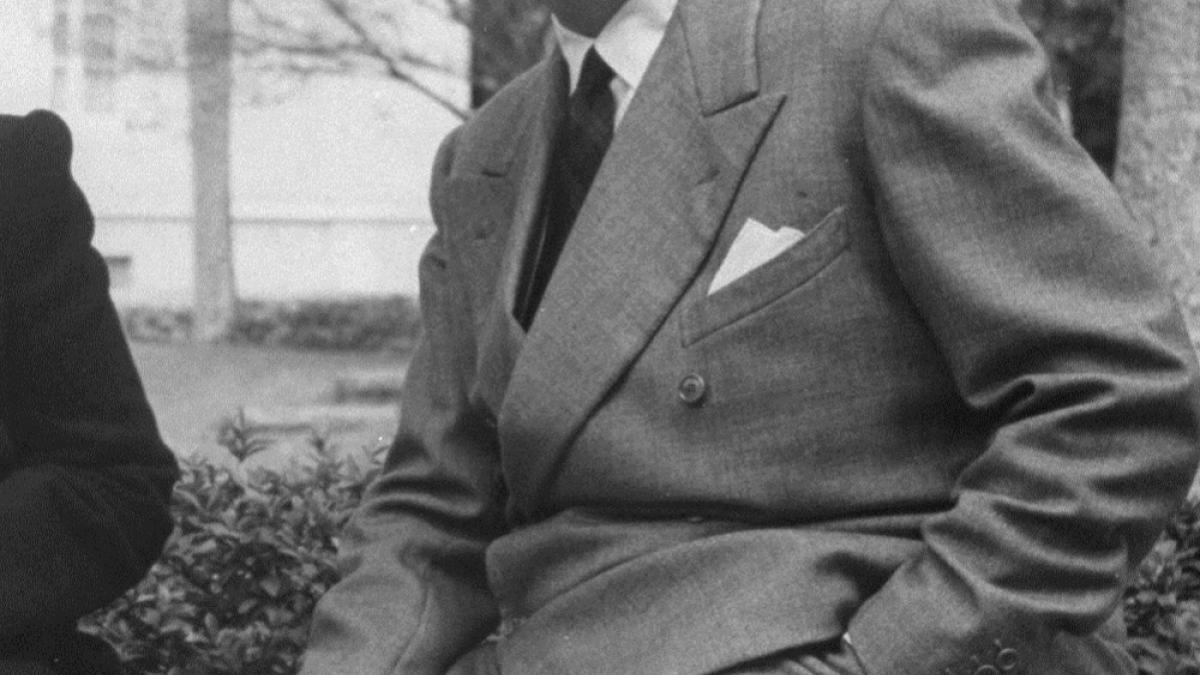
Francisco Matarazzo Sobrinho
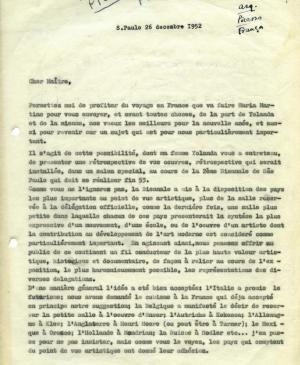
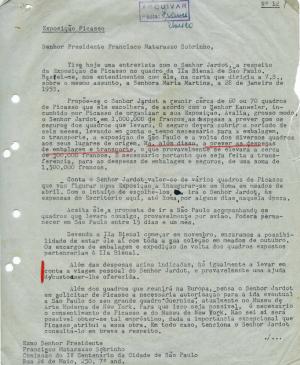
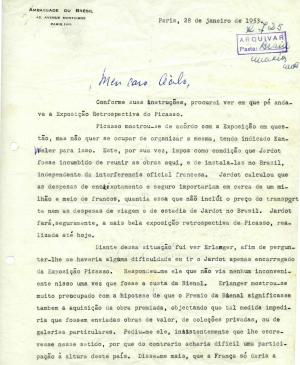
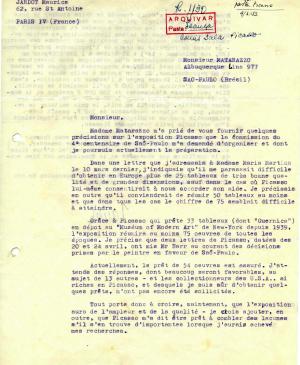
Francisco Matarazzo Sobrinho (São Paulo, 1898 – São Paulo, 1977), widely known as Ciccillo Matarazzo, was a Brazilian businessman, politician and patron of the arts of Italian descent who founded the Museu de Arte Moderna de São Paulo (1948) and the São Paulo International Biennial (1951). For the second edition of the Biennial (1953), Matarazzo Sobrinho managed to gain Picasso’s permission for the loan of Guernica for a retrospective on the artist, the only showing to date of the painting in Latin America.
As a promotor of the arts, collector and patron, Francisco Matarazzo Sobrinho, also known as Ciccillo, was a hugely important figure in Brazil’s art and culture scene, even more so after the creation of São Paulo’s Museu de Arte Moderna de São Paulo and the International Art Biennial. Matarazzo Sobrinho drew inspiration from the Venice Biennale, which he visited on a number of occasions, to organise the São Paulo Biennial with his wife, Yolanda Penteado. As president of the organising Committee for celebrating the Fourth Centenary of the city of São Paulo, one of Matarazzo Sobrinho’s main acts was to open the second edition of the Biennial in December 1953, in addition to endowing the Brazilian city with new and modern infrastructures, for instance the Ibirapuera Park, with an architectural complex designed by Oscar Niemeyer. As a theatre and film entrepreneur, he promoted the construction of the Teatro Brasileiro de Comédia (the Brazilian Comedy Theatre) and the film studios of the Companhia Cinematrográfica de Vera Cruz (Vera Cruz Film Company). Moreover, as a member of the Partido Social Progressista (Progressive Social Party), he was mayor of Ubatuba from 1964 to 1969.
The second edition of the São Paulo International Biennial, which sought to put Brazil on the map as the centre of art in Latin America, dedicated a major exhibition to Picasso, with Guernica its showpiece. The arrangements to secure the authorisation and permission of Pablo Picasso for the painting’s transfer were carried out by Francisco Matarazzo Sobrinho, along with Paulo Berrêdo Carneiro, the then ambassador of Brazil at the UNESCO headquarters in Paris, Maria Martins and Arturo Profili.